

CookiezyCookiezy
ProductPlatformsDocsPricingBlogContact
  1. Home/
  2. Docs/
  3. Strapi Adapter Setup

Docs navigation

Overview

DocsDeveloper-first documentation for installing, configuring, and verifying Cookiezy across every supported adapter.Getting StartedCheck readiness, generate the right package, then ship the core flow.InstallationInstallation follows the same core pattern everywhere: generate the issued package, register the hostname, install the adapter, and validate runtime verification before launch.ConfigConfiguration keeps locale, policy, categories, layout, and licensing context in sync.

Reference

APIDeveloper-facing runtime methods, browser events, and verification-aware integration notes.

Adapters

Webflow Adapter SetupTechnical Webflow setup guide for Cookiezy: what you receive after purchase, where each file goes, and how to validate the runtime on a published Webflow site.Shopify Adapter SetupTechnical Shopify setup guide for Cookiezy: download Platform Core, deploy the theme app extension, expose the Theme Editor fields, and validate storefront consent behavior before publish.Wix Adapter SetupTechnical Wix setup guide for Cookiezy: host the custom-code package, wire head and footer snippets, and validate licensing and audit behavior after purchase.Headless Adapter SetupTechnical headless setup guide for Cookiezy: boot the plain adapter, wire runtime verification, and validate the audit, settings, and restricted-mode recovery flow in custom frontends.WordPress Adapter SetupTechnical WordPress setup guide for Cookiezy: upload the plugin ZIP, configure licensing-aware settings, and validate shortcode-based settings and audit behavior.React Adapter SetupTechnical React setup guide for Cookiezy: load the plain adapter from the app shell, gate optional services with consent state, and validate SPA behavior.Next.js Adapter SetupTechnical Next.js setup guide for Cookiezy: load the plain adapter from the root layout, keep policy routing localized, and validate consent gating across App Router pages.Strapi Adapter SetupTechnical Strapi setup guide for Cookiezy: keep the runtime on the frontend, use Strapi as a configuration bridge, and map locale-aware policy URLs through the shared core model.
Overview

Strapi adapter: headless CMS bridge

Use this path when Strapi provides content and settings, while the frontend site is responsible for loading the Cookiezy runtime, banner, scanner, and policy page audit.

  • • Keep the actual Cookiezy scripts on the frontend site.
  • • Use Strapi to manage `defaultLocale`, `localeRoutes`, and policy URL mappings.
  • • Pass licensing fields through the generated frontend config.
  • • Mount the live cookie audit on the published frontend policy page, not inside Strapi admin.
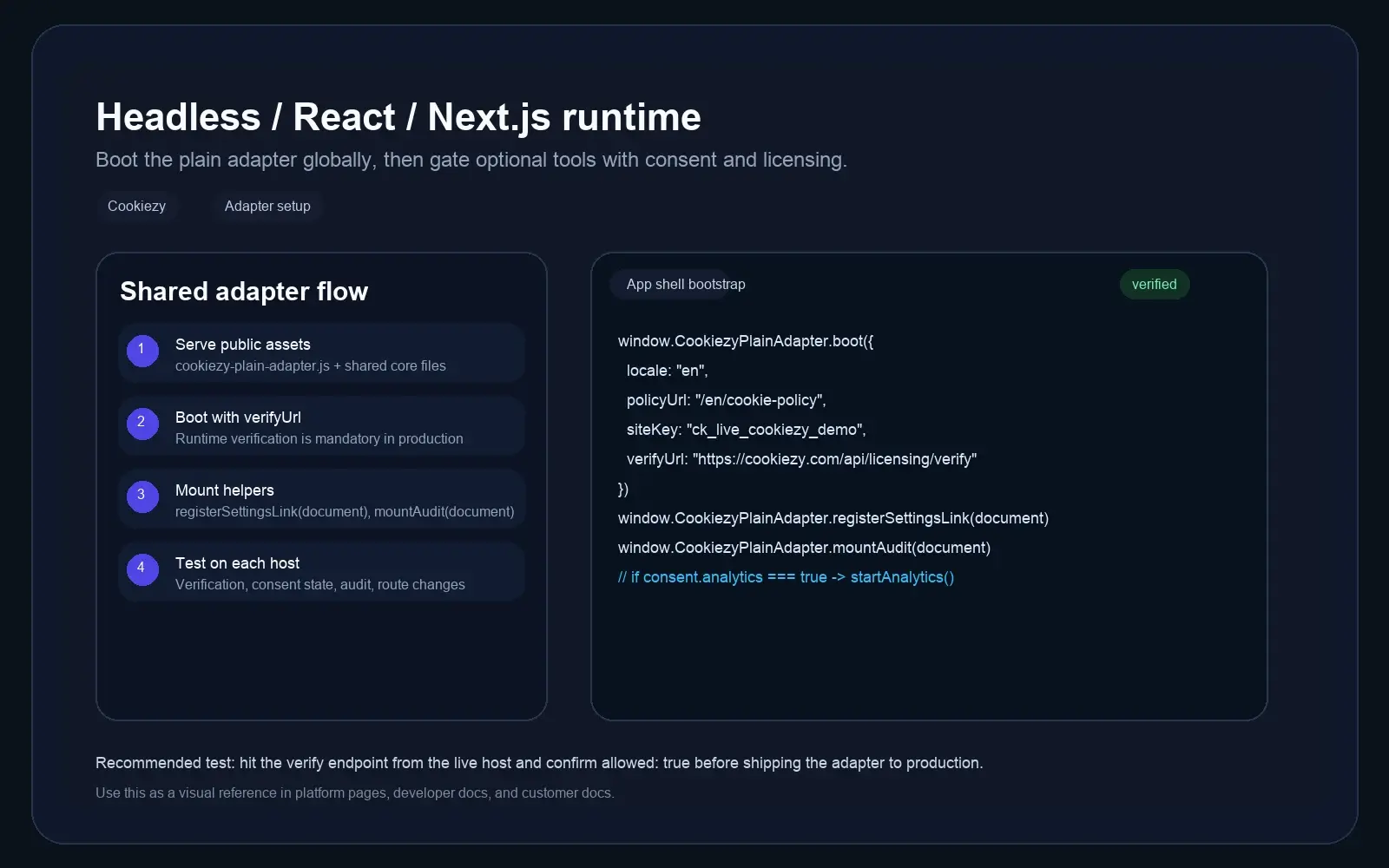
Developer documentation screenshot for the Cookiezy headless adapter showing shell bootstrap and licensing verification.
Strapi follows the same frontend runtime pattern as other headless setups, with Strapi acting as the config layer.
Step 1

Serve the runtime from the frontend shell

The frontend still loads the shared CSS, the canonical Strapi bridge file, a bootstrap step that maps Strapi settings into `window.CookiezyConfig`, and only then the core runtime, UI, and scanner. Important: `cookie-consent.js` must load after the Strapi adapter boot step.

Cookiezy

Lightweight consent platform for modern websites.

Product

FeaturesPlatformsPricingDocsBlogContact

Legal

Cookie PolicyPrivacy PolicyTerms

Language

Privacy controls

© 2026 Cookiezy. All rights reserved.

Code snippet

<link rel="stylesheet" href="/cookiezy/cookie-consent.css" />
<script src="/cookiezy/cookiezy-strapi-adapter.js"></script>
<script>
  window.CookiezyStrapiAdapter.boot(
    window.CookiezyStrapiAdapter.buildConfigFromStrapiSettings(strapiSettings)
  );
</script>
<script src="/cookiezy/cookie-consent.js"></script>
<script src="/cookiezy/cookie-consent-ui.js"></script>
<script src="/cookiezy/cookie-consent-scanner.js"></script>
Step 2

Map Strapi settings into the shared Cookiezy config

Read the settings from Strapi and turn them into the same runtime object used by other adapters. This keeps locale, policy URL, layout, and licensing consistent across platforms.

Code snippet

const strapiSettings = {
  defaultLocale: "en",
  localeRoutes: {
    en: { policyUrl: "/en/cookie-policy", pathPrefixes: ["/en"] },
    sl: { policyUrl: "/sl/politika-piskotkov", pathPrefixes: ["/sl"] }
  },
  storageKey: "strapi_cookie_consent_v1",
  theme: { layout: "bottom-right" },
  license: {
    siteKey: "ck_live_cookiezy_demo",
    verifyUrl: "https://cookiezy.com/api/licensing/verify",
    billingUrl: "https://cookiezy.com/en/billing"
  }
};

window.CookiezyStrapiAdapter.boot(
  window.CookiezyStrapiAdapter.buildConfigFromStrapiSettings(strapiSettings)
);
Multilang

Use Strapi locales to feed `localeRoutes`

If Strapi already stores localized page data, keep a matching locale-to-policy mapping in the Cookiezy settings model. The shared core can then resolve the correct language and policy page from the current frontend route.

  • • Use the same locale codes in Strapi and the frontend runtime where possible.
  • • Keep `pathPrefixes` aligned with the frontend router, not the Strapi admin URL structure.
  • • Each locale should point to the correct published policy page.
Plugin direction

Plugin-ready, but still frontend-first

A future Strapi plugin can provide a better admin editing flow, saved parameters, and a generated config preview. It should not replace the frontend runtime or try to own browser-side consent execution.

  • • Recommended future plugin scope: settings screen, generated config preview, install checklist.
  • • Do not treat Strapi admin as the place where the visitor-facing banner runs.
  • • Keep the published frontend responsible for audit mounting and pre-consent blocking tests.
Example

Use the included Next.js + Strapi example as your starting point

The package now includes a concrete `examples/strapi-nextjs/` flow with an App Router layout, a frontend bootstrap component, a Strapi fetch helper, and a localized cookie policy page example.

  • • Read settings from the Strapi plugin endpoint on the server.
  • • Convert Strapi locale routes into the shared Cookiezy runtime shape.
  • • Boot Cookiezy from the Next.js shell with `CookiezyStrapiAdapter`.
  • • Mount the audit block on the published policy page.
React example

A React + Strapi example is included too

The package also includes `examples/strapi-react/` for SPA-style teams. It shows a React shell provider that reads settings from Strapi, loads Cookiezy assets once, and mounts the policy-page audit on the frontend route.

  • • Use a single shell-level `CookiezyProvider` in React.
  • • Fetch Strapi plugin settings once and turn them into the shared runtime config.
  • • Load Cookiezy scripts only once from the app shell.
  • • Mount the audit block on the React cookie policy route.
Testing

Strapi rollout checklist

Validate both the CMS-config layer and the published frontend behavior before launch.

  • • Frontend boot receives the expected values from Strapi.
  • • Hostname verification returns `allowed: true` on the live site.
  • • Banner language matches the active locale route.
  • • Cookie policy page opens the correct locale-specific URL.
  • • Audit mount renders and re-scan reflects the current browser session.
  • • Restricted mode still blocks optional behavior when billing or verification is inactive.